Sunday, May 31, 2015

Week 9: Art + Space

Never have I been so amazed yet so felt so insignificant than by learning about space this week. Listening to Carl Sagan talk about the humbling experience that is astronomy ironically left me inspired. Perhaps it was his soothing voice, or perhaps the music and images, but I simply cannot imagine the future of mankind without imagining the possibilities in space. Will Arthur C. Clarke’s vision of a space elevator become reality? Will we see daily launches into space like in Gattaca? Will there be battles in space similar to current battles on Earth, like in Star Trek or Star Wars? What about, more realistically, humans colonizing Mars? Artists, scientists, and writers alike seem to believe there’s no future without space. As Clarke puts it, there will come a time when there will be “more people living outside of Earth than on it.”


It seems unfair to me to ponder and muse about the future of space without considering the rich and thrilling culture of space that developed in the 20th century. I can only imagine the awe ordinary people must have felt in 1969 when man walked on the moon for the first time. And maybe it’s better to not think about the heartbreak they felt less than 17 years later after the Challenger disaster. On the other side of the world the Soviets were dealing with their own trials and tribulations with the launch of Sputnik, Laika, and Gagarin. Given the context of the tense Cold War, staunch patriotism only made the race more exciting.
"Earthrise." We always talked about the rise of the moon and sun, but never the Earth. Space travel gave us a new perspective.
http://www.nasa.gov/sites/default/files/297755main_gpn-2001-000009_full_0_0.jpg


Going back further to the 16th and 17th century we see different yet still heated movements in science and our exploration of space with Copernicus, Kepler, and Galileo. This brings to my mind the question: how will historians and artists depict our own time in the future in regards to space? What are we to be excited about? While I don’t believe there will be space elevators any time soon, I find today’s technology nothing short of fascinating. Below is a video showing SpaceX’s Falcon 9 rocket crashing and exploding after attempting to land on a barge in the ocean following its launch into space! While it was unsuccessful, the proximity to success alone is amazing considering the unprecedented nature of the event.


People also often forget about Voyager 1, which was a space probe launched in 1977 that continues to operate to this day and communicates with Earth even though it is beyond our solar system. To put this in perspective, you could fit over one and a half million Earths between the probe and Earth now. So I hope when we are depicted in the future it is done with the intent to show boundless ambition -- that we believed the moon was not enough. 

Works Cited:


"Audacious & Outrageous: Space Elevators." - NASA Science. Web. 01 June 2015. <http://science.nasa.gov/science-news/science-at-nasa/2000/ast07sep_1/>.
"Major Figures of the Scientific Revolution." . Web. 01 June 2015. <http://users.clas.ufl.edu/ufhatch/HIS-SCI-STUDY-GUIDE/0064_majorFiguresSciRev.html>.
"News and Archive" Voyager 1. Web. 01 June 2015. <http://voyager.jpl.nasa.gov/news/pale_blue_25.html>.
"The Space Race." History.com. A&E Television Networks, Web. 01 June 2015. <http://www.history.com/topics/space-race>.
Wall, Mike. "Awesome New SpaceX Video Shows Rocket Landing Try and Crash | Space.com."  Web. 01 June 2015. <http://www.space.com/29119-spacex-reusable-rocket-landing-crash-video.html>.


Sunday, May 24, 2015

Week 8: Nanotech + Art

The 21st century is all about going big, but in a small way – on a nano-scale that is. When Richard Feynman issued his challenge of building a motor that was 0.4mm per dimension, he had no idea we would today be building carbon nanotubes just nanometers in diameter. More impressive perhaps is the Scanning Tunneling Microscope (STM), which exploits the tunneling phenomenon of tiny particles in order to resolve the contours and troughs and peaks of molecules. This has additionally allowed us to manipulate the positions of atoms and molecules to makes words and even artistic configurations.

A rendering of carbon nano tubes.
http://upload.wikimedia.org/wikipedia/commons/5/53/Types_of_Carbon_Nanotubes.png


I found Chris Orfescu’s work in this field to be particularly exciting. Orfescu, a materials scientist by trade, not only creates art on a nano-scale but holds competitions for others to do the same. What happens here is a powerful scanning electron microscope is used to visualize an atomic structure, and this visualization is processed with various artistic techniques in order to make artworks.
One example of Orfescu's method is this piece by Dolores Kaufman. This takes the nano-sculpture and modifies it to look like a waterfall (and it was aptly entitled "Nano Niagra"). I found this very clever because, as Kaufman says, it "creates something so very large from something so very small, just as occurs in nature."
http://graphics8.nytimes.com/images/2008/01/17/technology/17NANO_NIAGRA.jpg


A more practical use of this technology can be found in the biotech realm, where scientists have discovered how to use bismuth nanoparticles in conjunction with a spectral Computed Tomography scanner to find a blood clot’s exact location. Gregory Lanza, a researcher at Washington University predicts more technology will be developed to not only find blood clots but also seal weak spots in the blood vessels. Given the tremendous rate at which innovations are being made today, this means there’s no telling what kind of medical procedures will be possible ten, twenty, or thirty years from now. In a hopeful vision for the future, we may just be able to inject certain nanoparticles to deal with any maladies for which today we may have to be hospitalized. 

The top image depicts a blood vessel with ruptured atherosclerotic plaque (with will develop into a clot) and the nanoparticles, are attracted to the protein fibrin in the blood clot. On the bottom left is an image of a traditional CT scan, which cannot distinguish between the blood clot and the calcium in the plaque. The spectral CT image however, shows the bismuth nanoparticles that are attracted to the fibrin.
http://nanowiki.info/img/clots.jpg

Works Cited

Ball, Philip. "Honey, I Shrank the Motor." The Guardian.  Web. 24 May 2015. <http%3A%2F%2Fwww.theguardian.com%2Fscience%2F2004%2Fjun%2F10%2Fscience.nanotechnology>.
Feder, Barnaby. "The Art of Nanotech." Bits The Art of Nanotech Comments.  25 Jan. 2008. Web. 25 May 2015. <http://bits.blogs.nytimes.com/2008/01/25/the-art-of-nanotech/?_r=0>.
Lovgren, Stefan. "Can Art Make Nanotechnology Easier to Understand?" National Geographic. National Geographic Society, Web. 25 May 2015. <http://news.nationalgeographic.com/news/2003/12/1223_031223_nanotechnology.html>.
"NanoArt International Online Competition." NanoArt International Online Competition.  Web. 25 May 2015. <http://nanoart21.org/nanoart_contest.html>.
"New Nanoparticles Make Blood Clots Visible." Nanowiki.  Web. 24 May 2015. <http%3A%2F%2Fnanowiki.info%2F%23%255B%255BNew%2520nanoparticles%2520make%2520blood%2520clots%2520visible%255D%255D>.
Viktor, Erik. "Nanotechnology Now." Nanotechnology Art Gallery. Web. 25 May 2015. <http://www.nanotech-now.com/Art_Gallery/erik-viktor.htm>.


Sunday, May 17, 2015

Week 7: Neuroscience + Art

With the rapid advancement of technology and physics in the 20th century came our ability to better investigate the brain, and this ultimately led to rising interest in neuroscience. In Neuroculture Frazzetto and Anker describe how neuroscience seeks to answer questions that will ultimately reveal aspects of our individuality. They also discuss how work in neuroscience has impacted the arts community. One I found particularly intriguing was Susan Aldworth’s ‘Between a Thing and a Thought,’ which incorporates fMRI photos of her brain that she drew upon, giving the definition of ‘self’ in ‘self-portrait’ a more modern meaning.


But what’s a more rigorous explanation of ‘thought’ and consciousness? The Arisaka Lab at UCLA seeks to understand the origin of consciousness itself by mapping the brain behavior of C. Elegans under various environments and stimuli. The C. Elegans were chosen specifically due to their relatively simple brain (only 302 neurons vs. 100 billion in humans) and because of the relative ease of working with them. The process of this study involves supplying an external stimulation, determining how the neurons react to this, and the steps that lead to the excitation of motor neurons to respond to the stimuli.
The neuron mapping of C. Elegans.
http://home.physics.ucla.edu/~arisaka/home/Biophysics/CElegans/files/stacks_image_131.png

A different study of the brain involves the unconscious. While this term was first used by Friedrich Schelling, it gained popularity thanks to Sigmund Freud, who claimed a larger part of the mind’s processes took place in the unconscious. He believed dreams were gateways to the unconscious, and psychoanalysis was the way to interpret dreams. Carl Jung advanced several of Freud’s ideas about the unconscious further, making claims such as “It is, however, true that much of the evil in the world comes from the fact that man in general is hopelessly unconscious”  in his The Spiritual Problem of Modern Man.
A picture of Freud's idea of the levels of the brain. Much like an iceberg, the bulk of it is below the surface.
http://upload.wikimedia.org/wikipedia/commons/thumb/b/be/Structural-Iceberg.svg/849px-Structural-Iceberg.svg.png


Of course, we cannot sneak up on the unconscious and take a photo to prove that it’s there, so we must look for indirect methods of studying it. I believe seeing the effects of psychedelic substances provides insight on parts of the mind to which we do not have access. Dr. Albert Hofmann, the first person to create LSD, stated that it gave him a “mystical experience of a deeper, comprehensive reality.” Aside from hinting at the existence of brain processes the un-altered mind does not have access to, this demonstrates the curious nature of the brain—how just a few micrograms of a certain substance can open a world previously undreamed of. 
An artistic interpretation of the effects of LSD.
http://fc00.deviantart.net/fs6/i/2005/113/3/7/LSD_by_RipRoaringReverend.jpg


Works Cited: 

"Carl Jung - Collective Unconscious." Carl Jung - Collective Unconscious.  Web. 17 May 2015. <http://www.carl-jung.net/collective_unconscious.html>.
Devlin, Hannah. "What Is Functional Magnetic Resonance Imaging (fMRI)?" Psych Central. Web. 17 May 2015. <http://psychcentral.com/lib/what-is-functional-magnetic-resonance-imaging-fmri/0001056>.
Ferro, Shaunacy. "Why Doctors Can't Give You LSD (But Maybe They Should)." Popular Science. Web. 17 May 2015. <http://www.popsci.com/science/article/2013-04/new-science-lsd-therapy>.
"Katsuhi Arisaka at UCLA - C. Elegans." Katsuhi Arisaka at UCLA - C. Elegans.  Web. 17 May 2015. <http://home.physics.ucla.edu/~arisaka/home/CElegans/>.
McLeod, Saul. "Unconscious Mind | Simply Psychology." Unconscious Mind | Simply Psychology. Web. 17 May 2015. <http://www.simplypsychology.org/unconscious-mind.html>.


Sunday, May 10, 2015

Week 6: Biotech + Art

“You are what you eat” – or at least that’s the old adage that seems to be reinforced in Gary Wenk’s article This is Your Brain on Food. It’s quite thought provoking to read how the chemicals in the food you eat mentally affect you only if they actually resemble some neurotransmitters in your brain. It’s also a sobering thought that food is itself not fundamentally different from drugs—in fact, food is just a type of drug. It affects our brains and who we are more than we realize, as is apparent from the “morphine-like chemicals” produced in your intestines after consuming things like milk and eggs. This raises the question of just how do we classify the human body and life, and I find artists’ point of view on this matter very intriguing.
Diagram showing the sheer complexity of the tiny mechanisms of the brain. Here we see neurotransmitters being released.
http://www.scienceofeds.org/wp-content/uploads/2012/06/Synaptic-Transmission-CSNforum.png

As Ellen Levy describes in her paper, classifying life is much more challenging than a simple biology book may lead you to believe. Entities like chimeras and cyborgs already seem difficult to classify as they take their defining characteristics from various groups. One may even ask: is it fair to classy life in groups at all? After all, we have seen the definition of life and humanity challenged decade after decade throughout history. The artist Stelarc, for example, had an Extra Ear” constructed on his arm, making life itself a canvas. Does its traditionally unnatural growth alter its classification?
Stelarc with the "Extra Ear"
http://www.fluxnetwork.net/wp-content/uploads/2012/05/Ear_On_Arm_Stelarc1.jpg

Even more interesting to me is having Darwinian principles forcefully applied to machines. By random mutations to the machine code, the technology is allowed to “evolve” and improve over time. Previously it seemed common sense to think evolution was exclusively a “life” phenomenon, but with this creative application of Darwinism to machines, the question of biotechnology’s effect on what life is becomes much more difficult to answer.

Chris Kelty goes a bit further with the topic of pushing the limits of what’s allowed of human creativity with his description of “outlaws, hackers, and Victorian Gentlemen.” I find his view of “creativity breeds creativity” on the matter quite accurate regarding the current state of affairs. I believe the mindset of the “outlaws” will indeed be the one that reaches the cure for cancer and malaria because it appears in history that countless great discoveries are made by those who were told what they were doing was ridiculous or even unethical. 
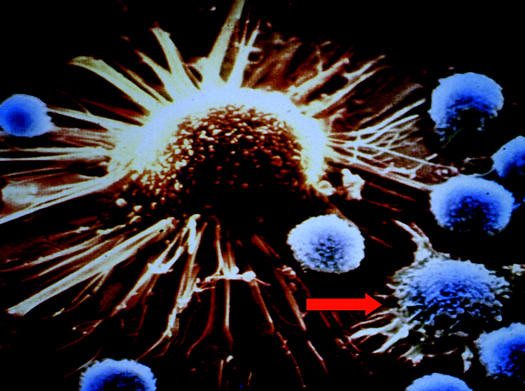
Tumor seeking immune system cells are being developed by UCLA researchers to  locate and attack dangerous melanomas.
http://farm5.static.flickr.com/4142/4919909041_26dc35d1bb_z.jpg


Works Cited:

"Ear on Arm." Web. 11 May 2015. <http%3A%2F%2Fwww.fluxnetwork.net%2Fear-on-arm-stelarc-at-the-media-gallery%2F>.
Sherweb. "5 Recent Breakthrough Innovations in Biotechnology | SherWeb." SherWeb. 23 Aug. 2010. Web. 11 May 2015. <http://www.sherweb.com/blog/5-recent-breakthrough-innovations-in-biotechnology/>.
Tetyana. "Benefits of Starving and Why You Don't Have a Chemical Imbalance." Web. 11 May 2015. <http%3A%2F%2Fwww.scienceofeds.org%2F2012%2F06%2F12%2Fanorexic-brain-neurocircuits-behaviour%2F>.
Wenk, Gary. "Seed Magazineabout." This Is Your Brain on Food . Web. 11 May 2015.
"What Is Biotechnology?" What Is Biotechnology?. Web. 11 May 2015. <https://www.bio.org/articles/what-biotechnology>.


Sunday, April 26, 2015

Week 4: Medicine, Technology, and Art

              The human body is doubtlessly a highly complex and intricate system, and the challenging endeavor of exploring it has allowed us to gain insight on what we’re made of and where we come from. I found Donald E. Ingber’s The Architecture of Life fascinating in its discussion of the cells. What stood out most to me was the explanation of what he called “molecular geodesic domes,” which are in essence the result of “tensegrity”. This idea resonated with me almost immediately because it occurred to me that it is the biological analog to the Principle of Least Action in physics. The Principle of Least action, which led to Lagrangian mechanics and Calculus of Variations, seeks to determine the path a mechanical system will take by minimizing the “action” of the motion. In Ingber’s terms, this would be similar to “offering a maximum amount of strength for a given amount of building materials” for the geodesic domes. It was amazing to me that life on a molecular scale is also ruled by the same principles that guide a rolling ball.
The Principle of Least Action will minimize the "action" of a mechanical system. Any path taken other than the red one in the center will be less efficient, similar to the mathematics behind the geodesic.
http://upload.wikimedia.org/wikipedia/commons/thumb/1/1c/Least_action_principle.svg/2000px-Least_action_principle.svg.png


                When technology meets life we get things like MRI machines, reconstructive surgery, heart transplants, cures for diseases, vaccines, among countless other things. I find MRI machines especially interesting because they perform a task that would once be considered witchcraft. Silvia Casini describes her surreal experience in such a machine and claims looking at the examination photos was like standing in “front of a mirror.” This forces me to think just what kind of “mirrors” we’ll have fifty or a hundred years from now.

Is it possible that scientists and engineers will invent technology similar to an X-Ray (but less harmful) that can be implemented in a phone for everyday people to use? There are already simple apps for smartphones that allow users to measure their heart rate and blood pressure.
http://culturax.org/wp-content/uploads/2014/07/on2_16655ced2.jpg


A slightly different but equally fascinating technological innovation is mitochondrial DNA (henceforth mtDNA) lineage tracking. You can now send in your sample of mtDNA and soon thereafter receive information regarding where your ancestors are from and in which migrations groups they belonged to. One setback of mtDNA, however, is that it only includes DNA from the maternal side, so the ancestral history of the father are non-existent in the tracing of the lineage. While not perfect, this is nevertheless a prime example of technology coming together with the bio-medical field to help us better understand who we are as humans and how we got here. 
Shows the various migration "haplogroups" by maternal lineage as discovered through mtDNA, a 21st century work of art as well as science.
https://www.ancestrybydna.com/library/images/map-maternal-zoom.jpg


Works Cited:

Engelking, Carl. "DNA Test Can Trace Your Ancestral Origins Back 1,000 Years - D-brief." Dbrief. 02 May 2014. Web. 26 Apr. 2015. <http://blogs.discovermagazine.com/d-brief/2014/05/02/dna-test-can-trace-your-ancestral-origins-back-1000-years/#.VT1gpCFViko>.

"Euler-Lagrange Equation: Chapter 2"  Web. <http://mathsci.kaist.ac.kr/~nipl/am621/lecturenotes/Euler-Lagrange_equation.pdf>.

Feynman, Richard. "The Feynman Lectures on Physics Vol. II Ch. 19: The Principle of Least Action." The Feynman Lectures on Physics Vol. II Ch. 19: The Principle of Least Action. Web. 26 Apr. 2015. <http://www.feynmanlectures.caltech.edu/II_19.html>.

Groleau, Rick. "Tracing Ancestry with MtDNA." PBS. Web. 26 Apr. 2015. <http://www.pbs.org/wgbh/nova/neanderthals/mtdna.html>.

"Magnetic Resonance Imaging (MRI)." Magnetic Resonance Imaging (MRI). Web. 26 Apr. 2015. <http://www.nibib.nih.gov/science-education/science-topics/magnetic-resonance-imaging-mri>.


Sunday, April 19, 2015

Week 3: Robotics and Art

It is difficult to think of many historical events more impactful than Industrialization. The growth of machines and industry brought about city life and affected the lives of just about anyone it came near. It’s easy to talk about the great things this did for the masses, but it’s also critically important to observe the negatives. William Blake writes in his poem The Chimney Sweeper:

                                That thousands of sweepers, Dick, Joe, Ned, & Jack,
                                Were all of them locked up in coffins of black;

This is one of many literary works lamenting the cruel child labor and nasty soot that followed industrialization. A great amount of rebellion was found among the masses as well, namely the Luddites, who fought against the automation of the early 19th century. Juxtaposing the tribulations of the population dealing with early industrialization with the idea that it was industrialization that paved the way for the modern technological revolution, one may have a difficult time forming a hard and fast opinion on the matter.
The dark and gloomy gases of early Industrialization filling the city.
https://www.mtholyoke.edu/courses/rschwart/hist255/la/smokestack2.jpg


A secondary topic on technology involves Walter Benjamin and reproduction of art. Aside from the political motivations and his apparent distaste for capitalism, Benjamin writes about the unavoidable loss of “aura” that is inherent in mechanical reproduction of art. A better understanding of the “aura” is supplied by Ludwig Klages (the German philosopher who coined the term for this context), and this entails seeing the “true meaning” of a given object in its “presence.” This is something that transcends the physical object and ultimately cannot be duplicated by any means.

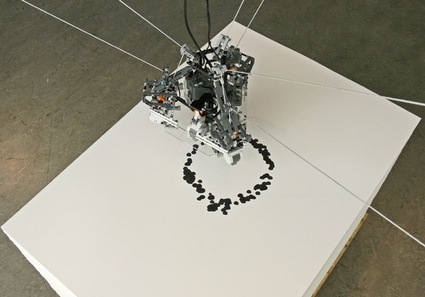
Does an "aura" exist for art made by a robot, which can be remade exactly over and over again?
http://www.we-make-money-not-art.com/wow/vuedessus2.jpg


Christopher Nolan’s The Prestige (a 2006 film) gives a different yet intriguing perspective on this topic by questioning the normative element attached to duplication. In short, the film follows two magicians who figure out how to duplicate themselves by using a machine created by Tesla. There are numerous times in the movie where the viewer is unsure of whether the person on screen is the original or not. In one of their illusions, the ‘magician’ would enter a box and seconds later appear at the other side of the venue. The magician, Angier, said near the end of the movie that it took immense courage to do this since he had no idea if he had to be the magician in the box or the one that appeared on the other side (the man in the box always drowned). The disturbing idea here is that not even the magicians knew who the original was – there was no original. As soon as the duplication occurred there were now two identical people with the same memories and experiences, and neither had any right to be the “original” or argue about “aura.” 
The Prestige. In the end we see all the containers of water Angier drowned his "duplicates" in to perform his trick, never knowing which was the original.
http://dailycaller.com/wp-content/uploads/2013/10/the-prestige-e1382993890627.jpg

---------------------------------------------------------
Works Cited

" A Brief History of Our Craft" History of the Chimney Sweep. Web. 18 Apr. 2015. <"http://www.ruchalachimney.com/history.html>.

"ArtBots Gent, the Robot Talent Show 2011." ArtBots: The Robot Talent Show. Web. 19 Apr. 2015. <http://artbots.org/2011/>.

Blake, William. "The Chimney Sweeper: When My Mother Died I Was Very Young." Poetry Foundation. Poetry Foundation, Web. 18 Apr. 2015. <http://www.poetryfoundation.org/poem/172910>.

"Ludwig Klages: Biocentric Metaphysics." Ludwig Klages: Biocentric Metaphysics.  Web. 19 Apr. 2015.

Poets.org. Academy of American Poets, Web. 19 Apr. 2015. <http://www.poets.org/poetsorg/poet/paul-val%C3%A9ry>.

The Prestige. Dir. Christopher Nolan. Perf. Hugh Jackman and Christian Bale. Buena Vista, 2006.

Sunday, April 12, 2015

Week 2: Math and Art

Asking people how closely related math and art are, one might say they are worlds apart. An analysis of early 20th century science and literature, however, reveals a tremendous nexus between the two. In The Fourth Dimension and Non-Euclidean Geometry in Modern Art, Linda Darlymple Henderson discusses a strange obsession that arose among artists and scientists alike in the early 1900's – the 4th dimension. Was this a scientific phenomenon or an artistic one? As Henderson elegantly explains, it was both. Duchamp, for one, found something “deliciously subversive” about the new geometries of the 4th spatial dimension and how it challenged long standing truths. This is a highly imaginative and social perspective on the topic. When Einstein revealed Relativity to the world people found out that ideas of the 4th dimension could be entirely explained by mathematics.
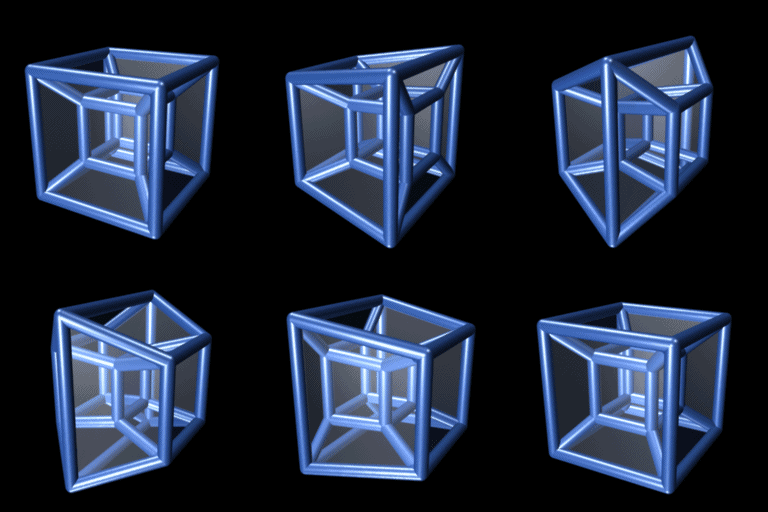
A Tesseract: The four dimensional analog to a cube. 


But even before Einstein, mathematics was found in literature. Edwin Abbot’s (A Square’s) Flatland delved into the puzzling the world of dimensions and became very well known when Einstein caused a resurgence of interest in dimensions. In addition to being a quirky piece of social commentary, it boldly asserted that there must be more dimensions than the three in which we live, and it did this with reasoning and logic by taking us on a journey through the eyes of a two dimensional figure that discovers the third dimension.

Movies are another art form that can be found to have mathematical bases. Good Will Hunting, for one, follows the tribulations of an un-ambitions and lost genius trying to discover what role mathematics is going to play in his life, and more importantly, what role he, as a mathematician, can play in society at large.

Looking at pieces of art and how they changed over the centuries one can easily see hundreds of ways mathematics is ingrained into them (such as vanishing point geometry). One that I found especially interesting is de Vinci’s Vitruvian Man.
The Vitruvian Man: A mathematical model of the "perfect" proportions of a man. 


Is this a work of art or math? Cases can be made for both, but clearly it is an exquisite example of the interplay of both fields.


The ultimate lesson I learned this week was that scientists and artists are not very different at all. In fact, they are both making an attempt to understand reality. Scientists are merely trying to reconcile mathematics with the external world they perceive and artists are trying to reconcile the laws of mathematics with an internal – a social and psychological – world they want to understand. 
What appears to be an intricate artistic design can actually be drawn in a matter of seconds by someone who knows very little about drawing. This is done with the help of mathematics and symmetry encoded into a web program, and about 15 seconds of  my time. With the aid of math, the limits of what a more talented artist can do are even more boundless than before. 


-----------------------
Sources:

Abbott, Edwin Abbott. Flatland: A Romance of Many Dimensions.

De Vinci, Leonardo. Vitruvian Man

"Gustav Mahler." Bio. A&E Television Networks, 2015. Web. 12 Apr. 2015.

Redd, Nola Taylor. "Einstein's Theory of General Relativity: A Simplified          Explanation." http://www.space.com/17661-theory-general-relativity.html. Web. 13 Apr. 2015.

"Silk – Interactive Generative Art." Silk – Interactive Generative Art.  Web. 13 Apr. 2015.

"Tesseract." -- from Wolfram MathWorld.  Web. 13 Apr. 2015.